













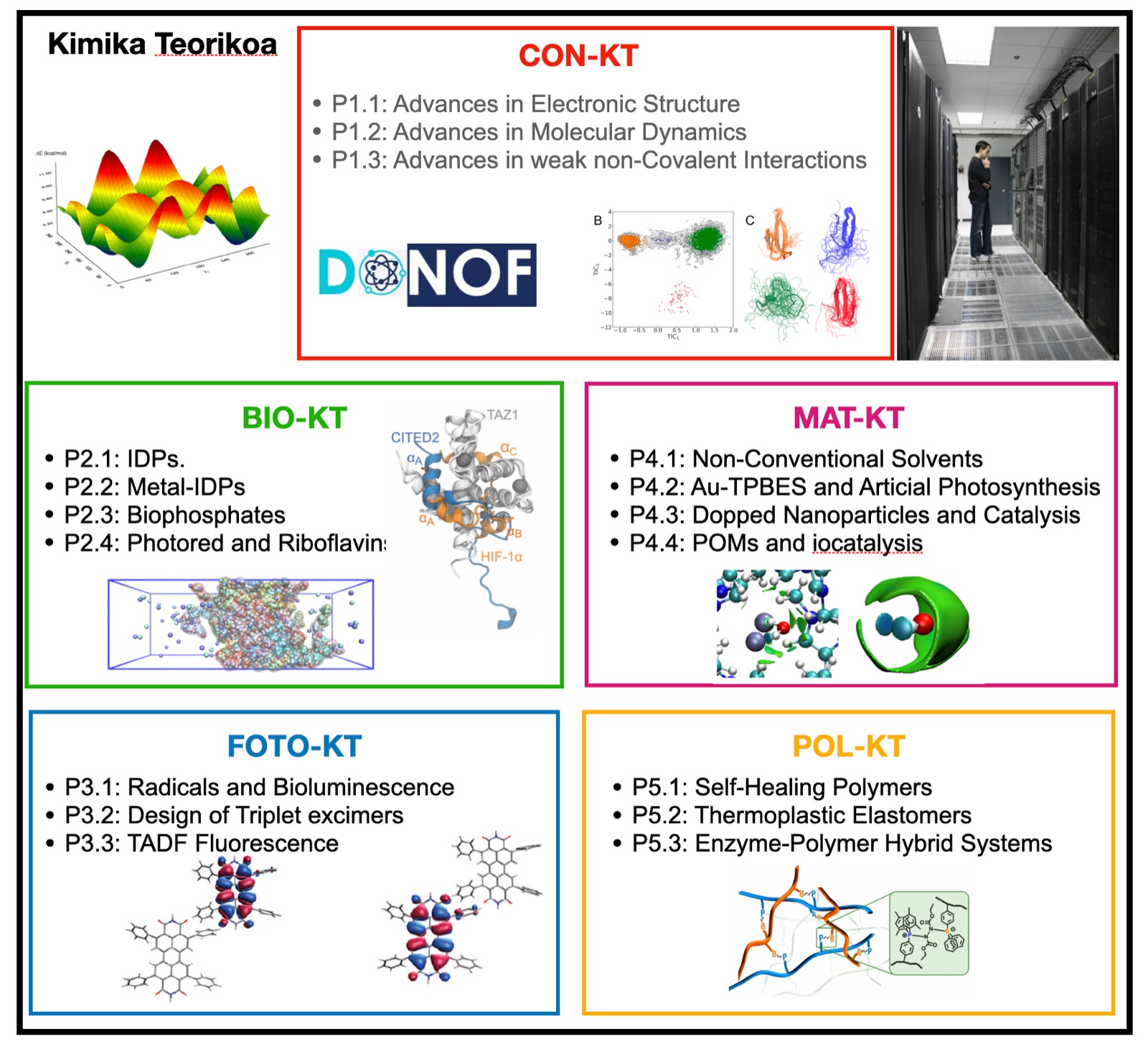
Research Lines
Publications
1.
Gholami, Samira; Aarabi, Mohammad; Grabowski, Sławomir J.
Theoretical Insights into Bifurcated Intramolecular Dihydrogen Bonds Journal Article
In: ChemPhysChem, vol. 25, no. 4, 2024, ISSN: 1439-7641.
Abstract | Links | BibTeX | Tags: and Optics, Atomic and Molecular Physics, Physical and Theoretical Chemistry
@article{Gholami2024,
title = {Theoretical Insights into Bifurcated Intramolecular Dihydrogen Bonds},
author = {Samira Gholami and Mohammad Aarabi and Sławomir J. Grabowski},
doi = {10.1002/cphc.202300849},
issn = {1439-7641},
year = {2024},
date = {2024-02-16},
journal = {ChemPhysChem},
volume = {25},
number = {4},
publisher = {Wiley},
abstract = {Abstract Two‐ring intramolecular π‐electron delocalization assisted dihydrogen bonds existing in (1Z,4Z)‐1,4‐dipentene‐3‐bora‐1,5‐diol and its symmetrically substituted derivatives have been analysed here since the MP2/6‐311++G(d,p) calculations on these systems were performed. The influence of the coexistence of two intramolecular dihydrogen bonded rings in these molecular structures on properties of intramolecular dihydrogen bonds as well as on the π‐electron delocalization within these rings was investigated. The comparison with corresponding structures of typical two‐ring, so‐called resonance‐assisted, RAHB, systems was performed. The results of calculations show that such rings′ coexistence leads to the weakening of dihydrogen bonds, similarly as for the typical two‐ring RAHB systems. The Quantum Theory of ‘‘Atoms in Molecules’’ (QTAIM) was also applied here to get more details about the nature of dihydrogen bonds. Correlations between dihydrogen bond strength measures and other energetic, geometrical and topological parameters were also analysed. It was found that characteristics of bond critical points as well as of ring critical points are useful to estimate the strength of intramolecular dihydrogen bonds in two‐ring dihydrogen bonded systems discussed here. The Natural Bond Orbital, NBO, approach parameters are also discussed as useful ones to describe properties of dihydrogen bonded systems. },
keywords = {and Optics, Atomic and Molecular Physics, Physical and Theoretical Chemistry},
pubstate = {published},
tppubtype = {article}
}
2.
Azpitarte, Oksana; Zudaire, Ane; Uranga, Jon; Lopez, Xabier; Salassa, Luca; Formoso, Elena; Rezabal, Elixabete
One‐ and Two‐Electron Reductions in MiniSOG and their Implication in Catalysis** Journal Article
In: ChemPhysChem, vol. 24, no. 15, 2023, ISSN: 1439-7641.
Abstract | Links | BibTeX | Tags: and Optics, Atomic and Molecular Physics, Physical and Theoretical Chemistry
@article{Azpitarte2023,
title = {One‐ and Two‐Electron Reductions in MiniSOG and their Implication in Catalysis**},
author = {Oksana Azpitarte and Ane Zudaire and Jon Uranga and Xabier Lopez and Luca Salassa and Elena Formoso and Elixabete Rezabal},
doi = {10.1002/cphc.202300091},
issn = {1439-7641},
journal = {ChemPhysChem},
volume = {24},
number = {15},
publisher = {Wiley},
abstract = {Abstract The unconventional bioorthogonal catalytic activation of anticancer metal complexes by flavin and flavoproteins photocatalysis has been reported recently. The reactivity is based on a two‐electron redox reaction of the photoactivated flavin. Furthermore, when it comes to flavoproteins, we recently reported that site mutagenesis can modulate and improve this catalytic activity in the mini Singlet Oxygen Generator protein (SOG). In this paper, we analyze the reductive half‐reaction in different miniSOG environments by means of density functional theory. We report that the redox properties of flavin and the resulting reactivity of miniSOG is modulated by specific mutations, which is in line with the experimental results in the literature. This modulation can be attributed to the fundamental physicochemical properties of the system, specifically (i) the competition of single and double reduction of the flavin and (ii) the probability of electron transfer from the protein to the flavin. These factors are ultimately linked to the stability of flavin‘s electron‐accepting orbitals in different coordination modes. },
keywords = {and Optics, Atomic and Molecular Physics, Physical and Theoretical Chemistry},
pubstate = {published},
tppubtype = {article}
}