














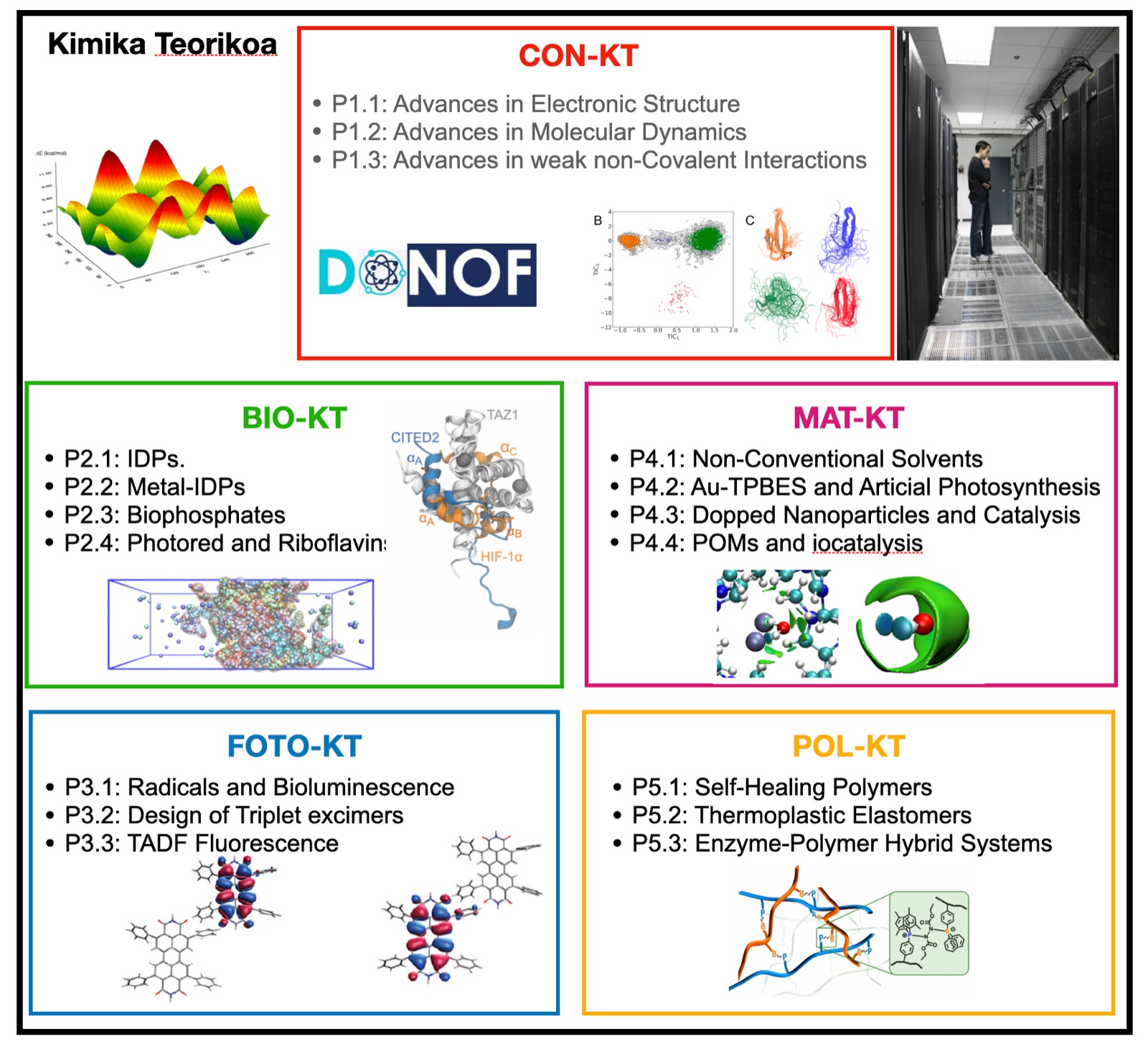
Research Lines
Publications
Lew-Yee, Juan Felipe Huan; Bonfil-Rivera, Iván Alejandro; Piris, Mario; del Campo, Jorge M.
Excited States by Coupling Piris Natural Orbital Functionals with the Extended Random-Phase Approximation Journal Article
In: J. Chem. Theory Comput., vol. 20, no. 5, pp. 2140–2151, 2024, ISSN: 1549-9626.
Links | BibTeX | Tags: Computer Science Applications, Physical and Theoretical Chemistry
@article{Lew-Yee2024,

title = {Excited States by Coupling Piris Natural Orbital Functionals with the Extended Random-Phase Approximation},

author = {Juan Felipe Huan Lew-Yee and Iván Alejandro Bonfil-Rivera and Mario Piris and Jorge M. del Campo},

doi = {10.1021/acs.jctc.3c01194},

issn = {1549-9626},

year  = {2024},

date = {2024-03-12},

journal = {J. Chem. Theory Comput.},

volume = {20},

number = {5},

pages = {2140--2151},

publisher = {American Chemical Society (ACS)},

keywords = {Computer Science Applications, Physical and Theoretical Chemistry},

pubstate = {published},

tppubtype = {article}

}
Rivero-Santamaría, Alejandro; Piris, Mario
Time evolution of natural orbitals in ab initio molecular dynamics Journal Article
In: J. Chem. Phys., vol. 160, no. 7, 2024, ISSN: 1089-7690.
Abstract | Links | BibTeX | Tags: General Physics and Astronomy, Physical and Theoretical Chemistry
@article{RiveroSantamaría2024,

title = {Time evolution of natural orbitals in \textit{ab initio} molecular dynamics},

author = {Alejandro Rivero-Santamaría and Mario Piris},

doi = {10.1063/5.0188491},

issn = {1089-7690},

year  = {2024},

date = {2024-02-21},

urldate = {2024-02-21},

journal = {J. Chem. Phys.},

volume = {160},

number = {7},

publisher = {AIP Publishing},

abstract = {<jats:p>This work combines for the first time ab initio molecular dynamics (AIMD) within the Born–Oppenheimer approximation with a global natural orbital functional (GNOF), an approximate functional of the one-particle reduced density matrix. The most prominent feature of GNOF-AIMD is its ability to display the real-time evolution of natural orbitals, providing detailed information on the time-dependent electronic structure of complex systems and processes, including reactive collisions. The quartet ground-state reaction N(4S) + H2(1Σ) → NH(3Σ) + H(2S) is taken as a validation test. Collision energy influences on integral cross sections for different initial rovibrational states of H2 and rotational-state distributions of the NH product are discussed, showing a good agreement with previous high-quality theoretical results.</jats:p>},

keywords = {General Physics and Astronomy, Physical and Theoretical Chemistry},

pubstate = {published},

tppubtype = {article}

}
Gholami, Samira; Aarabi, Mohammad; Grabowski, Sławomir J.
Theoretical Insights into Bifurcated Intramolecular Dihydrogen Bonds Journal Article
In: ChemPhysChem, vol. 25, no. 4, 2024, ISSN: 1439-7641.
Abstract | Links | BibTeX | Tags: and Optics, Atomic and Molecular Physics, Physical and Theoretical Chemistry
@article{Gholami2024,
title = {Theoretical Insights into Bifurcated Intramolecular Dihydrogen Bonds},
author = {Samira Gholami and Mohammad Aarabi and Sławomir J. Grabowski},
doi = {10.1002/cphc.202300849},
issn = {1439-7641},
year = {2024},
date = {2024-02-16},
journal = {ChemPhysChem},
volume = {25},
number = {4},
publisher = {Wiley},
abstract = {Abstract Two‐ring intramolecular π‐electron delocalization assisted dihydrogen bonds existing in (1Z,4Z)‐1,4‐dipentene‐3‐bora‐1,5‐diol and its symmetrically substituted derivatives have been analysed here since the MP2/6‐311++G(d,p) calculations on these systems were performed. The influence of the coexistence of two intramolecular dihydrogen bonded rings in these molecular structures on properties of intramolecular dihydrogen bonds as well as on the π‐electron delocalization within these rings was investigated. The comparison with corresponding structures of typical two‐ring, so‐called resonance‐assisted, RAHB, systems was performed. The results of calculations show that such rings′ coexistence leads to the weakening of dihydrogen bonds, similarly as for the typical two‐ring RAHB systems. The Quantum Theory of ‘‘Atoms in Molecules’’ (QTAIM) was also applied here to get more details about the nature of dihydrogen bonds. Correlations between dihydrogen bond strength measures and other energetic, geometrical and topological parameters were also analysed. It was found that characteristics of bond critical points as well as of ring critical points are useful to estimate the strength of intramolecular dihydrogen bonds in two‐ring dihydrogen bonded systems discussed here. The Natural Bond Orbital, NBO, approach parameters are also discussed as useful ones to describe properties of dihydrogen bonded systems. },
keywords = {and Optics, Atomic and Molecular Physics, Physical and Theoretical Chemistry},
pubstate = {published},
tppubtype = {article}
}
Ugartemendia, Andoni; Mercero, Jose M.; de Cózar, Abel; Melander, Marko M.; Akola, Jaakko; Jimenez‐Izal, Elisa
Deposited PtGe Clusters as Active and Durable Catalysts for CO Oxidation** Journal Article
In: ChemCatChem, vol. 16, no. 3, 2024, ISSN: 1867-3899.
Abstract | Links | BibTeX | Tags: Catalysis, Inorganic Chemistry, Organic Chemistry, Physical and Theoretical Chemistry
@article{Ugartemendia2024,
title = {Deposited PtGe Clusters as Active and Durable Catalysts for CO Oxidation**},
author = {Andoni Ugartemendia and Jose M. Mercero and Abel de Cózar and Marko M. Melander and Jaakko Akola and Elisa Jimenez‐Izal},
doi = {10.1002/cctc.202301137},
issn = {1867-3899},
year = {2024},
date = {2024-02-08},
journal = {ChemCatChem},
volume = {16},
number = {3},
publisher = {Wiley},
abstract = {Abstract Control of CO emissions raises serious environmental concerns in the current chemical industry, as well as in nascent technologies based on hydrogen such as electrolyzers and fuel cells. As for now, Pt remains one of the state‐of‐the‐art catalysts for the CO oxidation reaction, but unfortunately, it suffers from CO self‐poisoning. Recently, Pt−Ge alloys were proposed to be an excellent alternative to reduce CO poisoning. This work investigates the impact of Ge content on the CO oxidation kinetics of Pt4 Gen subnanoclusters supported on MgO. A Ge concentration dependence of the reaction kinetics is found due to a strong synergy between Pt and Ge. Pt−Ge nanoalloys act as a bifunctional catalyst by displaying dual adsorption sites; i. e., CO is adsorbed on Pt whereas oxygen binds to Ge, forming an alternative oxygen source GeOx . Besides, Ge alloying modifies the electronic structure of Pt (ligand effects) and reduces the affinity to CO. In this way, the competition between CO and O2 adsorption and the overbinding of CO is alleviated, achieving a CO poisoning‐free kinetic regime. Our calculations suggest that Pt4 Ge3 is the optimal catalyst, evidencing that alloying composition is a parameter of extreme importance in nanocatalyst design. The work relies on global optimization search techniques to determine the accessibility of multiple structures at different conditions, mechanistic studies and microkinetic modeling. },
keywords = {Catalysis, Inorganic Chemistry, Organic Chemistry, Physical and Theoretical Chemistry},
pubstate = {published},
tppubtype = {article}
}
Xu, Xiang; Soriano-Agueda, Luis; López, Xabier; Ramos-Cordoba, Eloy; Matito, Eduard
All-Purpose Measure of Electron Correlation for Multireference Diagnostics Journal Article
In: J. Chem. Theory Comput., vol. 20, no. 2, pp. 721–727, 2023, ISSN: 1549-9626.
Links | BibTeX | Tags: Computer Science Applications, Physical and Theoretical Chemistry
@article{Xu2023,

title = {All-Purpose Measure of Electron Correlation for Multireference Diagnostics},

author = {Xiang Xu and Luis Soriano-Agueda and Xabier López and Eloy Ramos-Cordoba and Eduard Matito},

doi = {10.1021/acs.jctc.3c01073},

issn = {1549-9626},

year  = {2023},

date = {2023-12-29},

urldate = {2024-01-23},

journal = {J. Chem. Theory Comput.},

volume = {20},

number = {2},

pages = {721--727},

publisher = {American Chemical Society (ACS)},

keywords = {Computer Science Applications, Physical and Theoretical Chemistry},

pubstate = {published},

tppubtype = {article}

}
Matxain, Jon M.; Huertos, Miguel A.
Hydrogen Tunneling in Stoichiometric and Catalytic Reactions involving Transition Metals Journal Article
In: ChemCatChem, vol. 15, no. 24, 2023, ISSN: 1867-3899.
Abstract | Links | BibTeX | Tags: Catalysis, Inorganic Chemistry, Organic Chemistry, Physical and Theoretical Chemistry
@article{Matxain2023,
title = {Hydrogen Tunneling in Stoichiometric and Catalytic Reactions involving Transition Metals},
author = {Jon M. Matxain and Miguel A. Huertos},
doi = {10.1002/cctc.202300962},
issn = {1867-3899},
year = {2023},
date = {2023-12-19},
journal = {ChemCatChem},
volume = {15},
number = {24},
publisher = {Wiley},
abstract = {Abstract Hydrogen tunneling is a type of quantum tunneling in which a hydrogen atom passes through a potential barrier without reaching the transition state governed by classical mechanics. The participation of hydrogen tunneling in a chemical reaction (stoichiometric or catalytic) can result in the formation of products that without this phenomenon would be impossible to achieve or would be formed in a very slow way. This concept paper aims to review some of the most representative examples of transition‐metal mediated chemical reactions involving hydrogen tunneling. The experimental tools to determine the possibility of the participation of quantum tunneling in a chemical reaction are presented. In addition, the theoretical methods that have been developed to calculate the effect of quantum tunneling on chemical reactions are discussed. Finally, from a personal perspective, the steps to be taken in order to predict and implement this phenomenon are proposed. },
keywords = {Catalysis, Inorganic Chemistry, Organic Chemistry, Physical and Theoretical Chemistry},
pubstate = {published},
tppubtype = {article}
}
Aarabi, Mohammad; Gholami, Samira; Grabowski, Sławomir J.
Double Centrosymmetric Si···π Tetrel Bonds as New Synthons─Evidence from Crystal Structures and DFT Calculations Journal Article
In: J. Phys. Chem. A, vol. 127, no. 47, pp. 9995–10007, 2023, ISSN: 1520-5215.
Links | BibTeX | Tags: Physical and Theoretical Chemistry
@article{Aarabi2023,

title = {Double Centrosymmetric Si···π Tetrel Bonds as New Synthons─Evidence from Crystal Structures and DFT Calculations},

author = {Mohammad Aarabi and Samira Gholami and Sławomir J. Grabowski},

doi = {10.1021/acs.jpca.3c06514},

issn = {1520-5215},

year  = {2023},

date = {2023-11-30},

journal = {J. Phys. Chem. A},

volume = {127},

number = {47},

pages = {9995--10007},

publisher = {American Chemical Society (ACS)},

keywords = {Physical and Theoretical Chemistry},

pubstate = {published},

tppubtype = {article}

}
Prieto-Pascual, Unai; Alli, Iñigo V.; Bustos, Itxaso; Vitorica-Yrezabal, Iñigo J.; Matxain, Jon M.; Freixa, Zoraida; Huertos, Miguel A.
Air-Stable 14-Electron Rhodium(III) Complexes Bearing Si,N Ligands as Catalysts in Hydrolysis of Silanes Journal Article
In: Organometallics, vol. 42, no. 20, pp. 2991–2998, 2023, ISSN: 1520-6041.
Links | BibTeX | Tags: Inorganic Chemistry, Organic Chemistry, Physical and Theoretical Chemistry
@article{Prieto-Pascual2023,

title = {Air-Stable 14-Electron Rhodium(III) Complexes Bearing Si,N Ligands as Catalysts in Hydrolysis of Silanes},

author = {Unai Prieto-Pascual and Iñigo V. Alli and Itxaso Bustos and Iñigo J. Vitorica-Yrezabal and Jon M. Matxain and Zoraida Freixa and Miguel A. Huertos},

doi = {10.1021/acs.organomet.3c00324},

issn = {1520-6041},

year  = {2023},

date = {2023-10-23},

journal = {Organometallics},

volume = {42},

number = {20},

pages = {2991--2998},

publisher = {American Chemical Society (ACS)},

keywords = {Inorganic Chemistry, Organic Chemistry, Physical and Theoretical Chemistry},

pubstate = {published},

tppubtype = {article}

}
Aduriz-Arrizabalaga, Julen; Mercero, Jose M.; Sancho, David De; Lopez, Xabier
Rules governing metal coordination in Aβ–Zn(
In: Phys. Chem. Chem. Phys., vol. 25, no. 40, pp. 27618–27627, 2023, ISSN: 1463-9084.
Abstract | Links | BibTeX | Tags: General Physics and Astronomy, Physical and Theoretical Chemistry
@article{Aduriz-Arrizabalaga2023,
title = {Rules governing metal coordination in Aβ–Zn(ii ) complex models from quantum mechanical calculations},
author = {Julen Aduriz-Arrizabalaga and Jose M. Mercero and David De Sancho and Xabier Lopez},
doi = {10.1039/d3cp02070c},
issn = {1463-9084},
year = {2023},
date = {2023-10-18},
journal = {Phys. Chem. Chem. Phys.},
volume = {25},
number = {40},
pages = {27618--27627},
publisher = {Royal Society of Chemistry (RSC)},
abstract = {QM cluster calculations explain the tendency found in the PDB of Aβ–Zn(ii ) complexes to be arranged in tetrahedral coordination shells with Zn(ii ) interacting with mixed His and Glu/Asp residues. },
keywords = {General Physics and Astronomy, Physical and Theoretical Chemistry},
pubstate = {published},
tppubtype = {article}
}
Dalmau, David; Crespo, Olga; Matxain, Jon M.; Urriolabeitia, Esteban P.
Fluorescence Amplification of Unsaturated Oxazolones Using Palladium: Photophysical and Computational Studies Journal Article
In: Inorg. Chem., vol. 62, no. 25, pp. 9792–9806, 2023, ISSN: 1520-510X.
Links | BibTeX | Tags: Inorganic Chemistry, Physical and Theoretical Chemistry
@article{Dalmau2023,

title = {Fluorescence Amplification of Unsaturated Oxazolones Using Palladium: Photophysical and Computational Studies},

author = {David Dalmau and Olga Crespo and Jon M. Matxain and Esteban P. Urriolabeitia},

doi = {10.1021/acs.inorgchem.3c00601},

issn = {1520-510X},

year  = {2023},

date = {2023-06-26},

journal = {Inorg. Chem.},

volume = {62},

number = {25},

pages = {9792--9806},

publisher = {American Chemical Society (ACS)},

keywords = {Inorganic Chemistry, Physical and Theoretical Chemistry},

pubstate = {published},

tppubtype = {article}

}
Grabowski, Sławomir J.
In: IJMS, vol. 24, no. 15, 2023, ISSN: 1422-0067.
Abstract | Links | BibTeX | Tags: Catalysis, Computer Science Applications, General Medicine, Inorganic Chemistry, Molecular Biology, Organic Chemistry, Physical and Theoretical Chemistry, Spectroscopy
@article{Grabowski2023,
title = {Ga···C Triel Bonds—Why They Are Not Strong Enough to Change Trigonal Configuration into Tetrahedral One: DFT Calculations on Dimers That Occur in Crystal Structures},
author = {Sławomir J. Grabowski},
doi = {10.3390/ijms241512212},
issn = {1422-0067},
journal = {IJMS},
volume = {24},
number = {15},
publisher = {MDPI AG},
abstract = {Structures characterized by the trigonal coordination of the gallium center that interacts with electron rich carbon sites are described. These interactions may be classified as Ga···C triel bonds. Their properties are analyzed in this study since these interactions may be important in numerous chemical processes including catalytical activities; additionally, geometrical parameters of corresponding species are described. The Ga···C triel bonds discussed here, categorized also as the π-hole bonds, do not change the trigonal configuration of the gallium center into the tetrahedral one despite total interactions in dimers being strong; however, the main contribution to the stabilization of corresponding structures comes from the electrostatic forces. The systems analyzed theoretically here come from crystal structures since the Cambridge Structural Database, CSD, search was performed to find structures where the gallium center linked to CC bonds of Lewis base units occurs. The majority structures found in CSD are characterized by parallel, stacking-like arrangements of species containing the Ga-centers. The theoretical results show that interactions within dimers are not classified as the three-centers links as in a case of typical hydrogen bonds and numerous other interactions. The total interactions in dimers analyzed here consist of several local intermolecular atom–atom interactions; these are mainly the Ga···C links. The DFT results are supported in this study by calculations with the use of the quantum theory of atoms in molecules, QTAIM, the natural bond orbital, NBO, and the energy decomposition analysis, EDA, approaches. },
keywords = {Catalysis, Computer Science Applications, General Medicine, Inorganic Chemistry, Molecular Biology, Organic Chemistry, Physical and Theoretical Chemistry, Spectroscopy},
pubstate = {published},
tppubtype = {article}
}
Azpitarte, Oksana; Zudaire, Ane; Uranga, Jon; Lopez, Xabier; Salassa, Luca; Formoso, Elena; Rezabal, Elixabete
One‐ and Two‐Electron Reductions in MiniSOG and their Implication in Catalysis** Journal Article
In: ChemPhysChem, vol. 24, no. 15, 2023, ISSN: 1439-7641.
Abstract | Links | BibTeX | Tags: and Optics, Atomic and Molecular Physics, Physical and Theoretical Chemistry
@article{Azpitarte2023,
title = {One‐ and Two‐Electron Reductions in MiniSOG and their Implication in Catalysis**},
author = {Oksana Azpitarte and Ane Zudaire and Jon Uranga and Xabier Lopez and Luca Salassa and Elena Formoso and Elixabete Rezabal},
doi = {10.1002/cphc.202300091},
issn = {1439-7641},
journal = {ChemPhysChem},
volume = {24},
number = {15},
publisher = {Wiley},
abstract = {Abstract The unconventional bioorthogonal catalytic activation of anticancer metal complexes by flavin and flavoproteins photocatalysis has been reported recently. The reactivity is based on a two‐electron redox reaction of the photoactivated flavin. Furthermore, when it comes to flavoproteins, we recently reported that site mutagenesis can modulate and improve this catalytic activity in the mini Singlet Oxygen Generator protein (SOG). In this paper, we analyze the reductive half‐reaction in different miniSOG environments by means of density functional theory. We report that the redox properties of flavin and the resulting reactivity of miniSOG is modulated by specific mutations, which is in line with the experimental results in the literature. This modulation can be attributed to the fundamental physicochemical properties of the system, specifically (i) the competition of single and double reduction of the flavin and (ii) the probability of electron transfer from the protein to the flavin. These factors are ultimately linked to the stability of flavin‘s electron‐accepting orbitals in different coordination modes. },
keywords = {and Optics, Atomic and Molecular Physics, Physical and Theoretical Chemistry},
pubstate = {published},
tppubtype = {article}
}
Silva-Brea, David; de Sancho, David; Lopez, Xabier
Influence of metal binding on the conformational landscape of neurofilament peptides Journal Article
In: Phys. Chem. Chem. Phys., 2023, ISSN: 1463-9084.
Abstract | Links | BibTeX | Tags: General Physics and Astronomy, Physical and Theoretical Chemistry
@article{Silva-Brea2023,
title = {Influence of metal binding on the conformational landscape of neurofilament peptides},
author = {David Silva-Brea and David de Sancho and Xabier Lopez},
doi = {10.1039/d3cp03179a},
issn = {1463-9084},
journal = {Phys. Chem. Chem. Phys.},
publisher = {Royal Society of Chemistry (RSC)},
abstract = {In order to understand the preferred modes of chelation in metal-binding peptides, quantum mechanical calculations can be used to compute energies, resulting in a hierarchy of binding affinities. },
keywords = {General Physics and Astronomy, Physical and Theoretical Chemistry},
pubstate = {published},
tppubtype = {article}
}