
Applied Fluid Mechanics Workshop
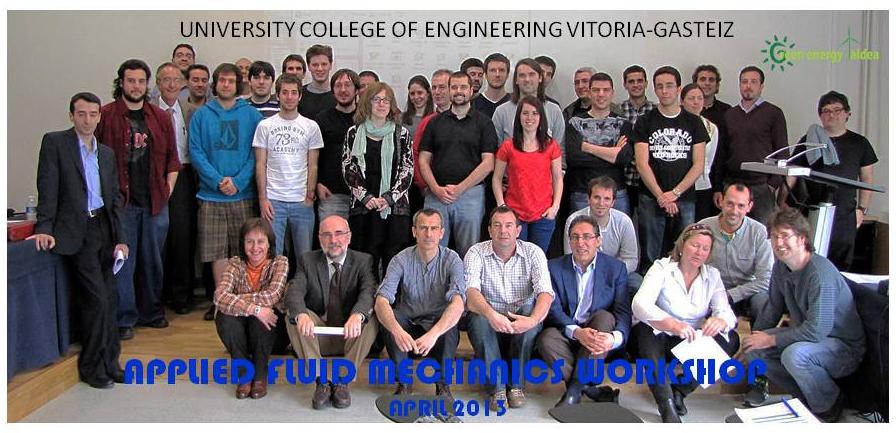
April 23rd 2013
University College of Engineering Vitoria-Gasteiz
Nieves Cano 12, 01006 Vitoria-Gasteiz.UPV-EHU UNIVERSITY OF THE BASQUE COUNTRY
09:00-9:15 Opening by UPV/EHU-GREEN ENERGY TALDEA
SESION 1: Clara M. Velte. Associated Professor Department of Mechanical Engineering Technical University of Denmark-DTU
9:15-10:00 Passive and active control strategies implemented in wind energy research at DTU.
SESION 2: Lakhdar Remaki. Research Professor BCAM-Basque Center for Applied Mathematics, Bilbao
10:00-10:45 Large Scale Simulations of Turbulent Flows for Industrial Applications.
10:45-11:15 Coffee Break.
SESION 3: Antonio Crespo. Emeritus Professor UPM-Technical University of Madrid.
11:15-12:00 Models of Wind turbine Wakes.
SESION 4: Ekaitz Zulueta. Associated Professor Automatic and Control Department, University of the Basque Country
12:00-12:45 Control Algorithmsfor Horizontal Axis Wind Turbines.
SESION 5: E. Ogando, JM Mercero. IZO-SGI SGIker, University of the Basque Country, UPV/EHU
12:45-13:30 IZO-SGI SGIker, Scientific Computing at the UPV/EHU
13:30-14:30 Time for discussion and conclusions.
ORGANIZERS
Unai Fernandez Gamiz, Javier Sancho Saiz and Ekaitz Zulueta. Please, if you want to attend this meeting send a confirmation e-mail before April 12th to Unai Fernandez Gamiz (unai.fernandez@ehu.es) with the name of participants and institution. More information in www.ehu.eus/get.
Event sponsored by: Departamento de Educación, Universidades e Investigación del Gobierno Vasco/Eusko Jaurlaritzako Hezkuntza, Hizkuntza Politika eta Kultura Saila and The University College of Engineering of VitoriaGasteiz
Clara M. Velte
As one of the leading universities in wind energy research, DTU is supported by an international Master's programme in Wind Energy, an international PhD school and a vast range of strong international research collaborations. Naturally, my own research has been strongly oriented towards wind energy, focusing on modeling vortex generators for wind turbine power output optimization. The investigations have primarily been experimental with focus on optical measurement techniques. This work has been very successful, resulting in an analytical model for vortex generators that can be applied on, e.g., wind turbines, airplanes, boat keels or even solar panels for increased power output/reduced fuel consumption. The technique thus has a large potential regarding economical savings for a range of engineering applications and provides a sound foundation for collaboration with both academia and industry.
Lakhdar Remaki
Industry's interest in CFD has sustained a phenomenal growth in the last 2 decades. Testing has become more closely coordinated with numerical simulations in order to reduce cost, better understand physical phenomena and save time in bringing products to market. In this talk the important role of CFD in industry will be demonstrated through two industrial projects and some numerical aspects will be discussed from the practical point of view. The first application that will be presented is the Bloodhound project which objective is constructing a vehicle to take the world Land Speed Record of 1000mph. The second application is related to preliminary results of a BCAM CFD platform for Turbo machinery simulation and design.
A. Crespo
Different models to simulate wakes in wind farms are reviewed. Special emphasis is put in those elaborated by the authors. First, kinematic models, based on self-similar velocity deficit profiles and global momentum conservation, are briefly revisited. Then, field models of a different degree of complexity, which solve numerically the flow equations with several types of simplifications and turbulence closure models, are analyzed and compared. Models that simple algebraic expressions for the eddy viscosity, and are still widely used, are compared to other more complete models like UPMWAKE, which uses a k-e turbulence closure. Ground effect, simulation of atmospheric conditions, atmospheric stability, simulation of turbulence characteristics, wake superposition and computer time consumed, will be used as terms of comparison. Results of an algebraic Reynolds Stress Model will also be presented, and compared with those of the k-e turbulence closure. Then a comparison will follow of elliptic and parabolic models, and how boundary conditions at the disk are imposed. A discussion on the displacement of the wake origin for parabolic models will be made. Results of a large eddy simulation model will also be presented and compared to those of previously mentioned models. Wake meandering, and its role in wake turbulence generation when using simpler eddy viscosity models will be analyzed, and compared with other mechanisms of turbulence generation. The possibility and convenience of introducing unsteady terms in parabolic field models of wind farms, like UPMPARK, and thus simulate wake meandering will be discussed.
E. Zulueta
E Zulueta is going to talk about his research in wind turbine control. He is developing different algorithms for speed set point. The objectives of these algorithms are the following ones:
- To obtain the maximum power production without power losses due to the wind "little" lacks.
- To obtain a secure time response when there is a high wind speed.
- To reduce the structure fatigue when we are operating at high wind speed.
We are applying Reinforcement Learning techniques to our speed setpoint policies. Now we want to model the wind turbine control as an Markov Decision Process because we think that the best approach because we have to take into account 3 main aspects: The wind regimes, the wind turbine control behavior and the wind turbine aeroelastic behavior.
E. Ogando, JM Mercero.
The IZO-SGI SGIker provides High Performance Computing (HPC) resources and human support not only to the UPV/EHU researchers but also to the Basque country scientific community. In the present talk we will describe the Service and we will summarize some of the research that is being done using ourresources.