
Hitzaldia: "Dynamics of Microsolvated(Bio)molecules". Prof. Jochen Küpper
Data
2026/10/13, 11:30
Ordutegia
Asteartea
Kokapena
Kokapena
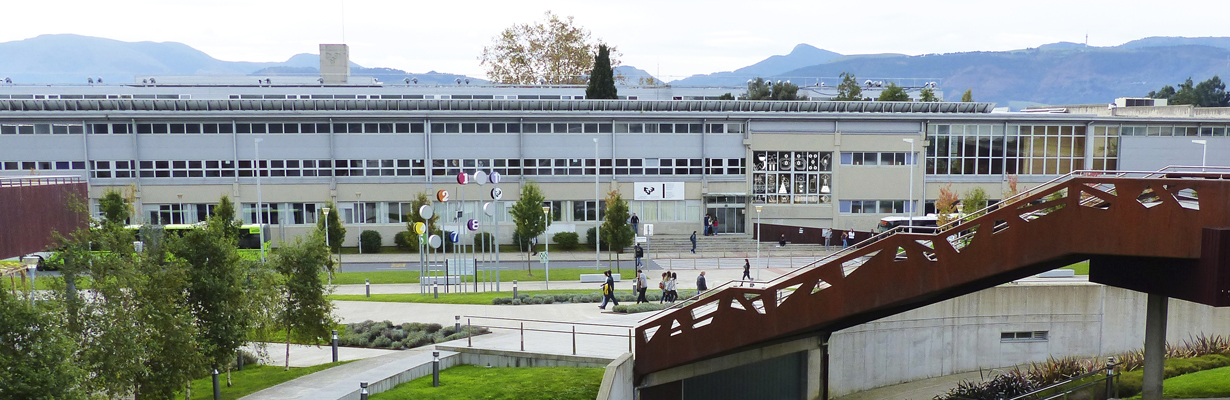
Adela Moyua gela - Zientzia eta Teknologia Fakultatea
Sarriena. -48940- Leioa-Erandio (Bizkaia)
Eguna: 2026ko urriaren13a
Ordua: 11:30etan
Tokia: Adela Moyua Gela
Hitzaldia: "Dynamics of Microsolvated(Bio)molecules".
Prof. Jochen Küpper. Center for Free Electron Lasers
(CFEL). Deutsche Electron Synchrotron (DESY), Hamburg
Abstract
Observing molecules in action through the recording of “molecular movies”, i.e., their spatiotemporal evolution during chemical dynamics with atomic spatial and temporal resolution, promises to provide a time-dependent foundation for chemistry. Yet, chemical dynamics are strongly affected by the molecular environment, and understanding how the properties of an isolated molecule evolve upon solvation remains a fundamental challenge. Microsolvated molecules provide a bottom-up route toward disentangling these effects one solvent molecule at a time.
We prepare highly controlled molecular samples for advanced imaging experiments on individual molecular species and directly in the molecular frame. Cold molecular beams and electric-field manipulation allow us to isolate specific microsolvated complexes and investigate their ultrafast dynamics.
I will discuss how individual water molecules modify the dynamics of prototypical biomolecular chromophores, focusing on pyrrole–water and indole–water and ongoing studies of uracil–water fragmentation. These experiments reveal pronounced changes in relaxation and fragmentation pathways, including the protection of ionized pyrrole against radiation-induced fragmentation.
Finally, I will connect this bottom-up perspective to larger biomolecular systems, including dehydration-induced structural changes in bacteriophage MS2 and recent experiments probing isolated protein complexes and their hydration. Together, these studies explore how water controls molecular structure and dynamics across widely different length scales.
Acknowledgments: This work was supported by DESY, a member of the Helmholtz Association, the German Cluster of Excellence “Advanced Imaging of Matter” (AIM, EXC 2056, ID 390715994), the BMFTR (Röntgen-Ångström Cluster project UDIET), and the Alexander von Humboldt Foundation. We acknowledge European XFEL for the provision of XFEL beamtime and the Maxwell computing resources at DESY